IN THIS POST

The Farber Fellowship is a consulting-like engagement that gives graduate students the opportunity and autonomy to work on a mission-critical project at a social enterprise in Redefine Alliance’s Community, over the course of one summer. The 2027 application cycle is approaching: learn more and view application details.
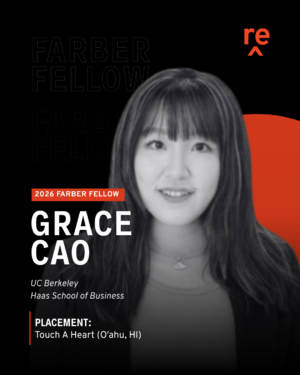 Before starting my MBA at UC Berkeley Haas, I spent several years in consulting, where I learned to approach business questions through markets, economics, and growth.
And through ten weeks with Touch A Heart and Baker’s Heart in Honolulu, I learned that sometimes the answers to those questions can’t be found in the numbers in a spreadsheet.
Touch A Heart is a nonprofit organization that creates opportunities for people overcoming barriers to employment. My project focused on how its employment social enterprise Baker’s Heart, which bakes and sells cookies, could grow earned revenue via new sales channels while staying true to its mission of providing vocational training and pathways to a sustainable life.
Over the course of this project, the team changed how I think about efficiency, growth, technology, and what it means to build a business around people.
Lesson 1: Sometimes “Inefficiency” Is the Point
Productivity is a core consideration for every business, and in consulting, we often look for ways to trim production costs or time.
But at Baker’s Heart, sometimes there’s value in a task taking longer. Maybe someone is learning it for the first time, or a team member pauses to explain something again. Sometimes efficiency gives way to patience because an apprentice needs room to make a mistake, try again, and build confidence.
In my prior work, that time might look like an inefficiency to fix. At Baker’s Heart, that time is the point.
Every cookie carries the obvious costs of ingredients, packaging, and labor. But it also carries something harder to quantify: the time required to teach, encourage, and give someone a meaningful opportunity to succeed.
Lesson 2: Growth Is Not Neutral
The realization that mission lives inside the business’ everyday operations changed how I understand growth.
We had to look beyond revenue projections in a spreadsheet to evaluate opportunities. Instead, we asked whether an opportunity could make Baker’s Heart stronger while creating more of the work it exists to provide.
Different opportunities create different kinds of jobs, require different levels of capacity, and place different demands on a team. An exciting opportunity on paper may not be the right one for the organization right now.
I learned to think more carefully about what growth enables, but also what it asks of people. Sometimes the most thoughtful decision is not to pursue an opportunity. Growth is not the goal by itself. The goal is business growth that also serves the mission.
Lesson 3: With AI, Building Is Easy. Adoption Is Hard.
The summer also changed how I think about technology, especially AI.
AI makes it remarkably easy to build a dashboard, automate an analysis, or create a new tool quickly. That possibility is exciting, especially when you only have ten weeks, but it also makes it incredibly easy to overbuild without providing additional value.
I learned to ask, “What can I build that will actually fit into the way this team works?”
That meant starting with how the team already made decisions, what information they already had, and what they could realistically maintain after I left. Instead of adding new systems simply because we could, I focused on tools that could fit into existing workflows and make everyday decisions easier.
As AI makes building easier, I think the harder and more important work is understanding people, workflows, and adoption. The best technology is the one people actually use.
Changing My Definition of “Useful”
Before this summer, “business as a force for good” was an idea I strongly believed in. Baker’s Heart made it much more tangible and the Touch A Heart team welcomed me into their ‘ohana’ with a generosity I will remember long after this fellowship.
Their mission of transforming the lives of those facing barriers to employment is woven into how people are trained, which opportunities are pursued, what technology is introduced, and how growth happens. Financial sustainability and impact are considered together every day.
I’m returning to Haas with the knowledge that the answer doesn’t always lie in the fastest process, biggest opportunity, or most sophisticated tool. And sometimes the extra minutes spent teaching someone how to make a cookie are not a cost to minimize, they are exactly the value you are trying to create.
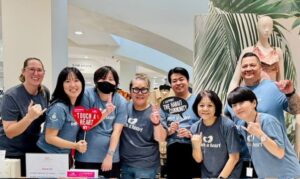
—Written by Grace Cao, Haas School of Business, University of California Berkeley
Read more about our 2026 Farber Fellows


