IN THIS POST

The Farber Fellowship is a consulting-like engagement that gives graduate students the opportunity and autonomy to work on a mission-critical project at a social enterprise in Redefine Alliance’s Community, over the course of one summer. The 2027 application cycle is approaching: learn more and view application details.
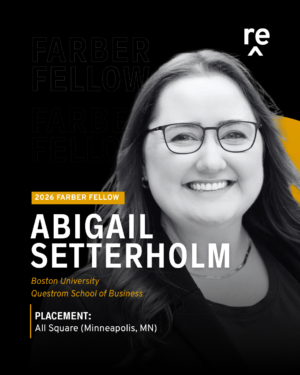
After a decade of working in nonprofits, I came to business school hoping to expand my horizons, learn more about the broader social impact ecosystem, and build the skills, knowledge, and networks needed to deepen my own impact. The Farber Fellowship was the perfect opportunity to blend my nonprofit and business worlds, and I was thrilled to be placed with an employment social enterprise (ESE) in my home state of Minnesota.
I spent the summer working with All Square — a craft grilled cheese restaurant and food truck — in reimagining its employee success program for justice-impacted individuals in the Twin Cities. Celebrating its 10th birthday in 2026, All Square is at an exciting inflection point and thinking intentionally about what its next chapter could look like.
Here are the most poignant lessons that I gleaned during my fellowship:
1. Strategy Requires Courage to Change
Relatively new to business consulting, I expected to spend the summer applying frameworks and benchmarking analysis to help guide All Square’s thinking. While I did plenty of that, my biggest takeaway was a lesson I had encountered many times in my nonprofit career but came to appreciate in a new way: strategy requires courage.
In the nonprofit space, there can be a strong feeling that “more is always better,” and that greater impact must mean more services, more programming, and more people reached. When needs are urgent and painfully clear, the idea of doing less or pulling back doesn’t just feel uncomfortable. It can feel like failure.
The reality is that no single organization can be everything for everyone or effectively meet every need it encounters. Resources, capacity, and expertise are limited. Often, the best way to deepen impact is to focus on the areas and populations where an organization is best positioned to make a meaningful difference.
At All Square, this meant revisiting the goals of their Fellowship, a professional development program for people returning home from prison, and thinking critically about how the program could best achieve them. As we refined the logic model and developed a staffing model to support it, we grappled with an important question: How do we balance our commitment to meeting participants’ needs with the operational and financial realities of running an effective social enterprise?
Answering that question required getting specific about what the Fellowship could realistically accomplish, while also being willing to revisit activities and approaches that had served a purpose in the past but might no longer be the best fit for the program’s evolving goals and needs.
2. Business is Personal, So Lead with Empathy
On paper, strategy can look like a straightforward exercise in weighing evidence and making trade-offs. My experience in nonprofit work has taught me that, in practice, changing a program can mean reconsidering things that people have invested significant time, resources, energy, and passion into building. There are real emotional and cultural stakes to these decisions.
Effective social impact strategy requires leading with empathy as much as evidence, and making space to acknowledge the people, history, and context behind strategic choices. As I saw this summer, taking the time to clarify priorities can bring difficult conversations, but also a sense of relief and renewed energy.
3. Learn from Your Peers
Some of my favorite moments of my Farber summer were conversations with ESE leaders in Redefine’s portfolio. I was struck by how eager these professionals were to take time out of their busy schedules to share resources, insights, and advice with me and All Square’s leadership.
More than that, they provided something harder to quantify but no less important: validation and reassurance that All Square was not navigating these questions alone. There is tremendous expertise and willingness to collaborate within this community, and I saw firsthand the value of learning from what others have already tried rather than reinventing the wheel.
I leave this experience with a more nuanced definition of strategy. It isn’t just about what you choose to do, it is also about what you thoughtfully choose not to do. Focus does not have to come from a deficit mindset about what an organization cannot accomplish. It can instead be asset-oriented: Where are we strongest? Where are we uniquely positioned to make a difference? Where can we go deeper rather than simply doing more?
For me, the best social impact strategy combines evidence, empathy, and the humility to learn from what has come before. And sometimes, choosing to do less, better, is one of the most courageous decisions an organization can make.
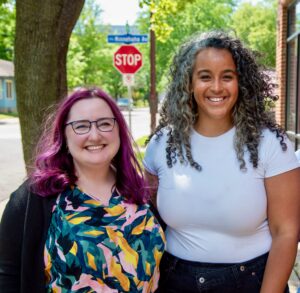
—Written by Abigail Setterholm, Boston University Questrom School of Business
Read more about our 2026 Farber Fellows


